

I’ve been talking with customers recently about how they’re using AI in their business development efforts. One theme keeps coming up: different models excel at different tasks.
At the PGA Show in January, I listened to Ross Liggett at Metolius Golf explain how he uses different models for different objectives. Claude for coding. ChatGPT for creative work. Perplexity when he needs a quick answer.
As it turns out, that’s almost exactly how I use them too.
That doesn’t mean you can’t be successful using a single LLM. But I do think it’s important for go-to-market and business development professionals to understand the relative strengths and weaknesses of each model.
Over the next month, we’ll be putting several leading AI models through a series of golf-related research tasks to see how they perform.
Part One: Give Me a List of Golf Courses
The first test was simple: “Give me a list of every daily fee and semi-private golf course in Rhode Island.”
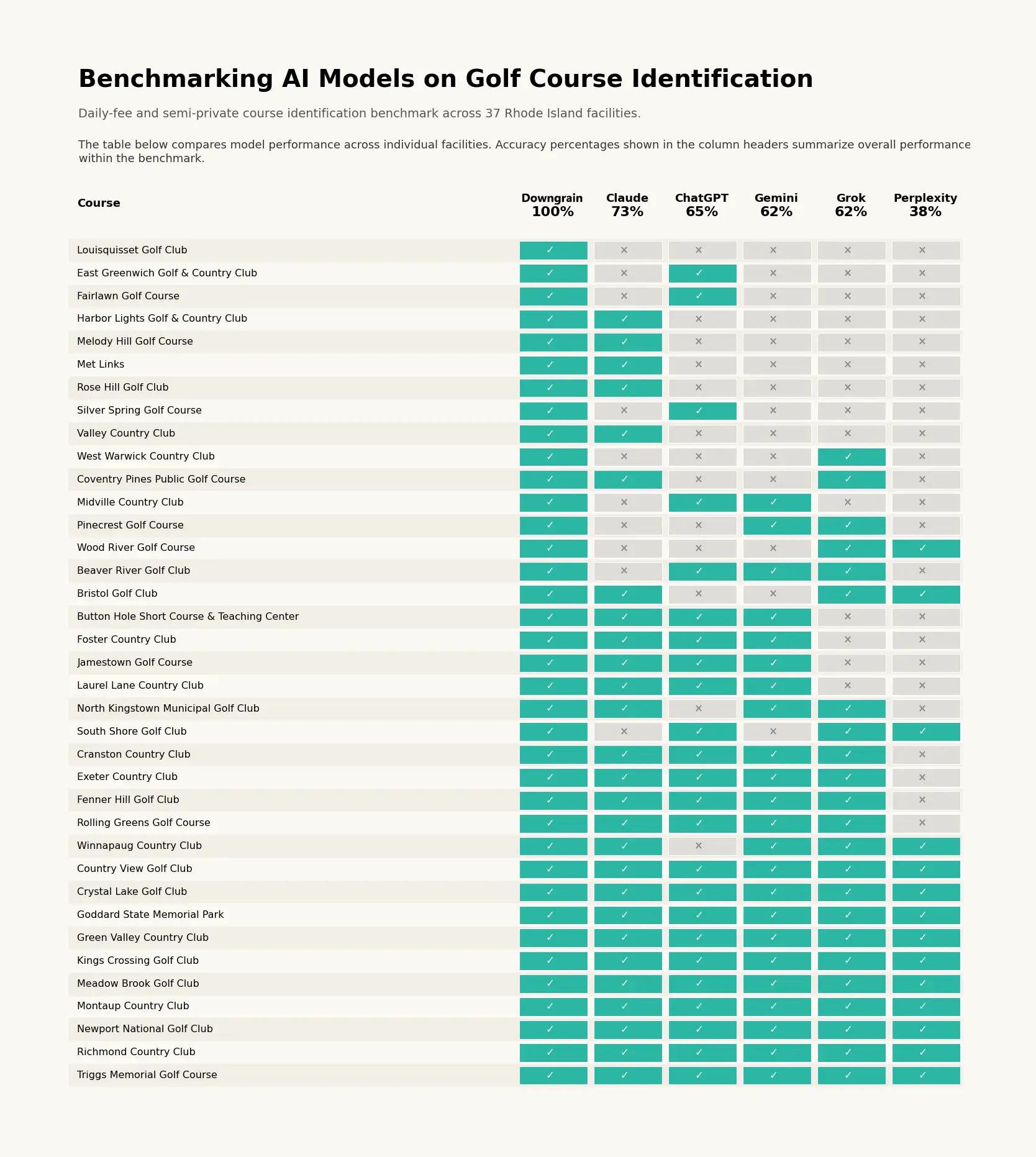
We know there are 37 daily fee and semi-private golf facilities in Rhode Island.
So how well did the best model perform? Claude produced the strongest result, identifying 27 of the 37 facilities. That might sound pretty good until you think about the practical application.
Imagine your goal was to play every public golf course in Rhode Island. You ask Claude for a list, start checking courses off one by one, and eventually finish every course it gave you.
You’d still have 10 courses left to play.
Not because they closed. Not because they opened recently. Because they were never on the list to begin with.
It gets worse.
ChatGPT included two private clubs that aren’t open to public play. It also listed Meadow Brook twice, once as “Meadow Brook” and once as “Meadowbrook.”
Perplexity was actually the most transparent. It cautioned that it wasn’t capable of producing a comprehensive list, identified only 14 facilities, and still included a private club by mistake.
As we examined the results, only 10 courses were identified by all five models. And then there’s Louisquisset Golf Club in North Providence. What did Louisquisset do to deserve this level of disrespect? None of the five models included it.
Now, Louisquisset is a 9-hole course, so we’re not talking about Pebble Beach. But we’re not talking about some obscure backyard pitch-and-putt either. Tee times are readily available, rates are typically between $45 and $75, the course has more than 300 reviews on GolfNow, and over 100 reviews on Google.
Yet somehow, every model missed it.
What Did We Learn?
I came away with two primary takeaways.
1. If you’re asking an LLM to build a list, Claude is currently your best option.
You’ll probably still miss 25-30% of the data, but that’s considerably better than the alternatives we tested.
2. You probably shouldn’t be asking LLMs to build lists from public data in the first place.
These tools weren’t designed to curate comprehensive datasets from scattered public sources. They’re answering questions, not maintaining databases.
On top of that, golf facility classifications can be nuanced. The distinction between a private club, a semi-private club, and a daily fee facility isn’t always obvious, even to people who work in the industry.
The result is predictable: incomplete lists, outdated information, and classification errors.
For brainstorming, summarization, and analysis, today’s AI models are incredibly useful.
For building comprehensive golf industry datasets, they still have a long way to go.
If you’re tired of relying on incomplete, outdated, or inaccurate facility data in your business development efforts, visit Downgrain.com and request a free trial of the most comprehensive golf facility intelligence platform in the industry.