


There’s no doubt that different regions of the United States produce golf courses of different types. Anyone who has played desert golf knows that it’s very different from playing the local municipal course in Ohio. Then, of course, you have windy coastal golf, mountain golf, and the lovely types of courses you find in the Nebraska Sandhills.
But which of these areas satisfy golfers the most?
Obviously, every area has its great courses, its good ones, and the ones that you swear to never visit again. But is it possible to analyze the overall experience provided to golfers by the golf courses of various states and regions?
It is now.
We Wanted More Than a Survey
No, we didn’t survey a handful of people in every state. We wanted more data.
We decided to dig deep into Google Review data.
For every golf course in America, we mapped the facility to its Google Places profile. This lets us do a lot of things—we can keep up with name changes or courses going out of business. But it also allows us to mine all of the review data.
A few months ago, we loaded all of this data into the Downgrain platform.
For teams selling into golf courses, the real value of this data is that it provides another way to identify which facilities are most likely to be in-market for a product or service.
For example, customers can filter out courses with fewer than 50 or 100 Google reviews. Those facilities are often rural, lower-traffic courses that may be less likely to have the budget or operational scale to invest in new software or services. By focusing on courses with a meaningful volume of reviews, sales teams can spend more time on facilities that are more likely to fit their ideal customer profile.
The same data can be used in the opposite direction. We work with customers that acquire, operate, or help turn around struggling golf facilities. For them, a course with a Google rating below 4.0 can be a useful signal that the facility may be experiencing operational or customer-experience issues.
Taken together, review volume and average rating give our users another way to segment the market and focus their efforts on the golf courses most likely to be relevant to what they sell.
The South Stands Out — And Not in a Good Way
Now that the data is in, it’s easy to answer the questions we posed earlier.
Are certain states, or certain regions, struggling to do their job of providing golf to consumers?
The answer is a resounding “yes.”
Just about any way you look at the data, states in the South lag behind their counterparts when it comes to customer satisfaction.
Seven of the 10 worst states in Google rating are in the South. The golf courses in Texas, Florida, and Arkansas bring up the rear with the lowest statewide ratings.
None of the states in the South are in the top 10 for customer satisfaction when you look at the ratings from golfers in those states.
If every course is weighted equally, Alabama brings up the rear with an average Google rating of 4.12.
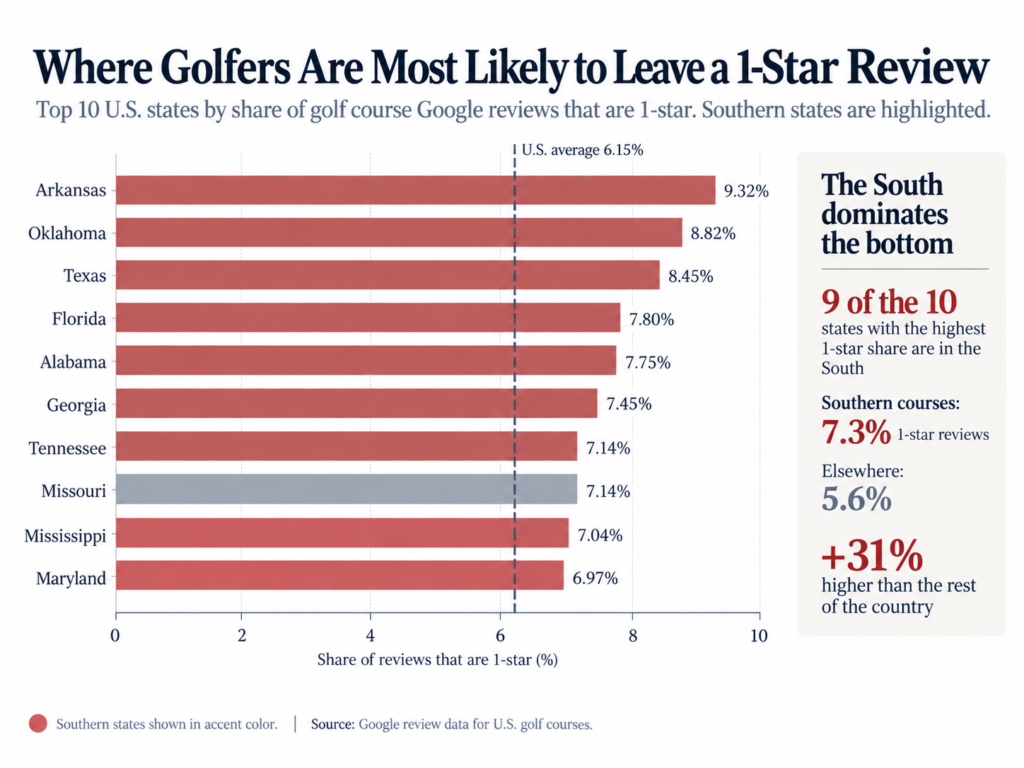
The 1-Star Reviews Tell an Even Stronger Story
But if we’re talking dissatisfaction, we should probably be looking at 1-star reviews, and not ratings, right?
After all, we’re trying to find out where golfers feel severely let down most often.
The data holds true:
Southern golf courses average about 4.22 stars with 7.3% 1-star reviews, versus roughly 4.32 stars and 5.6% 1-star reviews elsewhere.
That’s a meaningful gap: Southern courses receive about 31% more 1-star reviews.
Are Southern Golfers Just Harder to Please?
When I first crunched this data, I was a bit surprised.
I immediately theorized that maybe people in the South just have higher standards. But that didn’t comport with my personal experiences.
Southerners, as far as I could tell, were pretty laid-back. On average, they’re kinder than people in the Northeast or in California.
So I looked it up.
And the data shows that people in the South are actually easier graders than their counterparts in the Northeast or West.
According to the American Customer Satisfaction Index, consumers in the South tend to report slightly higher satisfaction across goods and services.
In fact, in 2026, the South had the highest customer satisfaction for electric utilities.
So what explains the dissatisfaction of golfers in the South?
Here are some of the most common theories.
Theory No. 1: Courses Stay Open When Conditions Aren’t Ideal
Courses in other regions close when conditions are unsuitable for golf.
Courses in the South stay open.
These courses in the South are open for more than a few months outside of peak playing conditions. While I’d argue that some golf is better than no golf, it’s easy to see why poor reviews may pour in during extreme weather or temperatures.
But if that were true, wouldn’t states like Arizona, California, and Nevada also carry poor ratings?
None of them are in the bottom 25% in average rating or percentage of 1-star ratings.
So that explanation doesn’t fully hold up.
Theory No. 2: Higher Prices Create Higher Expectations
Golf in these states tends to be more expensive than in other states.
Seventy percent of the public golf courses outside the South have green fee rates under $50, whereas only 58% of the courses in these Southern states can be had for that price.
So perhaps higher green fees bring higher expectations.
But once again, we look at states like California, Arizona, and Nevada, which have some of the most expensive public golf courses—and do not have such low ratings.
So price doesn’t appear to tell the whole story either.
So What’s Really Going On?
OK — so what’s the deal?
People in the South are not harsh reviewers. If year-round golf isn’t the culprit, and higher prices aren’t the culprit, what explains this?
We do know that golf courses in the South are generally more distressed than others.
While courses in the South make up 33% of all golf courses in America, 42% of all courses that have closed in the past 25 years are in the South.
So there’s definitely a signal indicating that golf courses in these regions struggle a bit more than those in other regions.
We may not know exactly why golfers in the South are less satisfied, but the data is clear: Southern golf courses are more likely to disappoint their customers—and more likely to struggle as businesses.