
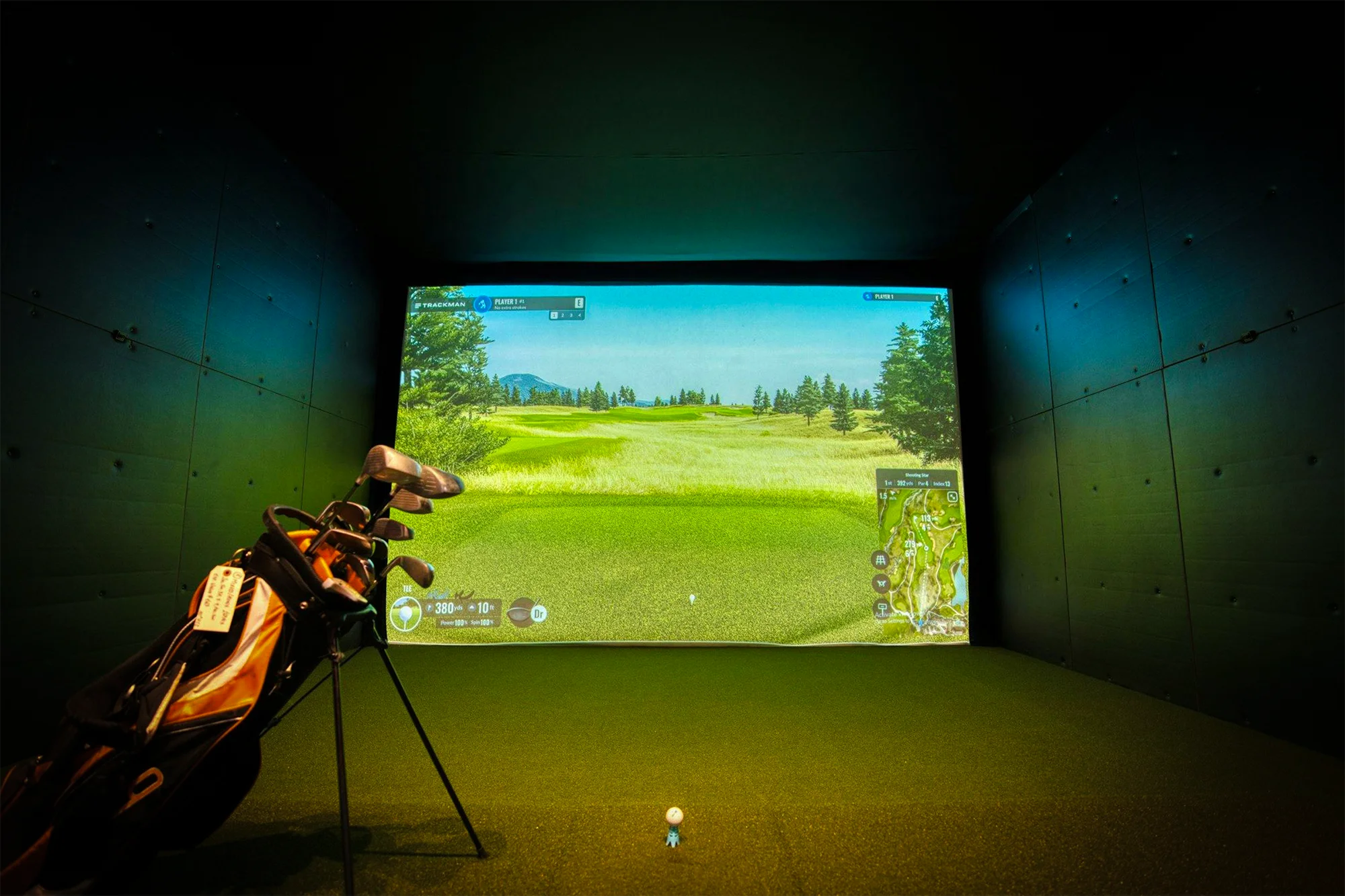

The National Golf Foundation’s most recent white paper on The Golf Simulator Opportunity estimates that 6.5%, or just over 900 green grass facilities, offer golf simulators for their members or patrons. This estimate is based on survey responses from 354 facilities, about 2.5% of all golf facilities. We appreciate the insights the NGF produces for the industry, though estimates based on small samples can sometimes miss the full picture of what is actually happening across the market.
So what’s this about? We’re here to report that the real number appears to be much higher. We can confidently identify 1,413 green grass facilities, more than 10% of all facilities, that definitively offer indoor simulators. How can we say this?
Downgrain offers Facility Features that are gathered by crawling every golf facility’s website along with their Facebook and Instagram posts. From these pages and posts we search for keywords and phrases that reveal the features offered at each facility. Do they have a driving range? Do they offer memberships? Is there event space, pickleball, or tennis? With keyword-based feature detection, questions like these, and nearly any question about facility amenities, become straightforward to answer.
The indoor golf boom is clearly underway, so naturally we decided to examine which golf clubs offer simulator play. What we found was simulators being mentioned in many different ways. Sometimes a club describes the simulator as an amenity. Other posts encourage members to sign up for simulator leagues. In many cases there are construction updates describing renovations that add a simulator to the clubhouse.
Because our dataset is dramatically larger than the typical survey sample used in industry reports, we are able to look at simulator adoption with much broader coverage across the market.
Below are some of the most interesting insights from the data.
Simulator Adoption at Green Grass Facilities Is Higher Than Reported
With more than 1,400 facilities identified, the minimum conclusion is that at least 10% of green grass golf facilities offer simulator experiences. In reality, the true number is almost certainly higher.
If we can point to 1,413 clubs that have publicly mentioned their simulator online, how many more have simulators but have never posted about them?
Some elite private clubs intentionally keep a low online profile. Other facilities are simply not very active on their websites or social media channels. If we conservatively assume that only 3% of the remaining facilities have simulators that were never mentioned online, the percentage of facilities with simulators would be roughly double what the NGF reported in 2025.
Municipal Golf Courses Are Falling Behind
When we examine simulator adoption across ownership types, daily fee facilities overall are not far from the industry average. However, when we split those daily fee facilities into municipal and non-municipal courses, a clear pattern emerges.
Only 7% of municipal facilities offer simulator play, compared to 11% of non-municipal daily fee facilities. In other words, non-municipal daily fee courses are about 57% more likely to offer simulators than their municipal counterparts.
One possible explanation is the difference in capital investment cycles. Municipal golf facilities often operate under public budgeting processes that make it harder to fund discretionary projects such as simulator installations. While private operators can invest quickly when they see an opportunity to generate off-season revenue or expand programming, municipal facilities may face longer approval timelines and competing priorities for public funding.
Northwest Golf Courses Lead the Nation in Simulator Adoption
It is not surprising that regions with year-round golf tend to show lower adoption of simulators. In the southern United States, for example, only about 3.6% of facilities advertise simulator play. Meanwhile, regions such as the Northern Rockies, Upper Midwest, and Ohio Valley are four to five times more likely to offer simulators.
But one region clearly stands above the rest: the Northwest.

Across Washington, Oregon, and Idaho, more than 16% of green grass facilities advertise indoor simulators. That is the highest regional concentration we found anywhere in the country.
What makes this particularly interesting is that golf can often be played nearly year-round in many major cities across this region, unlike parts of the Midwest or Ohio Valley where courses shut down for extended periods. This suggests that rainfall may be just as important as cold temperatures when it comes to driving simulator adoption.
Our Research Shows Why Better Market Intelligence Matters
Our research into simulator usage at green grass golf facilities is not just an academic exercise. Yes, it is interesting to analyze a dataset that is far larger than anything previously examined. But the real importance is practical.
There are real businesses selling indoor golf equipment, hardware, and accessories to golf clubs. Many of them are still going to market without a clear picture of where simulators already exist and where opportunities remain.
Time is money when building a sales pipeline. Without reliable intelligence guiding your go-to-market strategy, companies risk spending time and effort in the wrong places.
Better data leads to better decisions. Learn more about the data in the Downgrain platform today.