


Earlier this year, we walked through several trends that we uncovered from Downgrain’s data collection about new golf properties set to open in 2026 or beyond.
One new trend everyone seems to be talking about is the rise of 12-hole courses. But is this really happening? What does the data say?
So, Is This Really Happening?
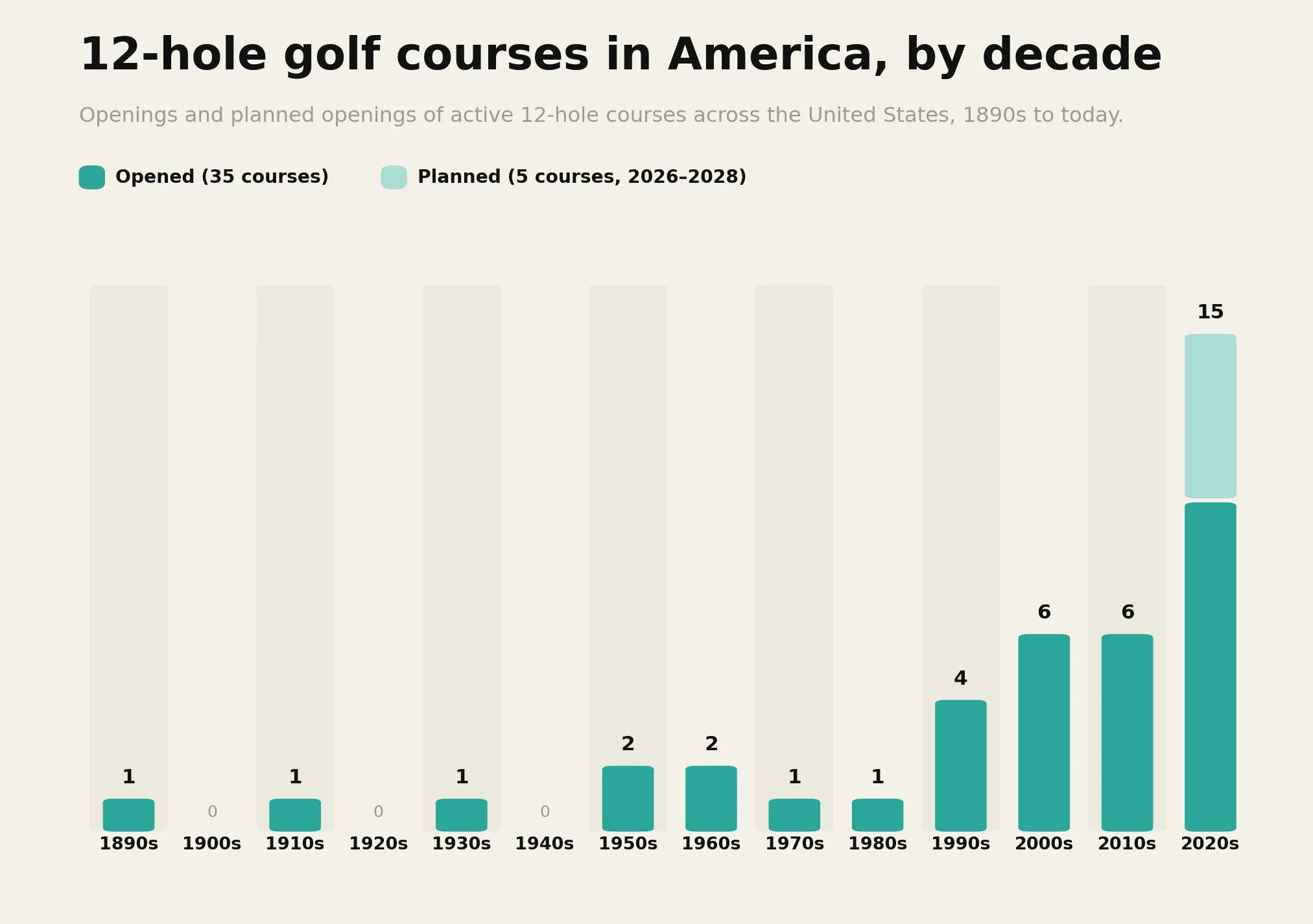
According to Downgrain’s catalog of active courses in America, there is undoubtedly a shift to 12-hole courses happening right now (counting new, standalone courses):
- More 12-hole courses have opened or been announced since 2014 than in all previous years combined.
- The number of courses with the shortened 12-hole format is set to grow by 13% once this year’s crop opens.
- Historically, 9-hole courses outnumbered 12-hole courses by more than 150 to 1. Today, among courses under construction, that gap has narrowed to less than 4 to 1.
Why are new 12-hole courses popping up like this? It could be part of recent, focused efforts to grow the game, as they’re a great fit for casual players who shudder at the thought of dedicating five hours to a round. They’re simply a logical solution to attract younger generations and others with notably shorter attention spans. Roy Bechtol, co-designer of Austin Beach Club in Texas, cited this as a key factor, saying “Millennials want to play golf in a way that takes less time and is more fun.”
Why Would Anyone Want This?
There are plenty of factors that tell us why the market might be ripe for a new format of golf:
- 18 holes often take well over four hours, not counting warmup time or the commute. Shorter courses give players an option when they have less time available to play (looking at you, fathers of two). This also serves as an entry point for new players to offer organic growth for the sport.
- As indoor sims grow in popularity, many of today’s players are already accustomed to their golf outings lasting only a handful of hours.
- Factoring in that 12-hole courses often feature short par 3’s, these shorter circuits can do a great job at getting players in and out in under two hours.
- It opens the door for golf as an after-work activity in more than just the summer months.
Plenty of key figures are already beginning to capitalize on the shift, even if they’re enduring the pain points along the way.
Six-time major winner Nick Faldo has come out as a huge fan of 12-hole golf. He sees an opportunity to cater to a modern society that has increasingly less time to devote to leisure activities.
“It’s taken 20-plus years but we’re finally getting people to go, ‘You know what? Eighteen is a lot. I can’t disappear from the family for six hours,’” Faldo said. “Pop down, do nine holes. Do 12. I’m a big fan of 12 holes, because you can do two sixes. Do another one and there’s your 18.”
But as his Faldo Designs company evaluates properties opening new courses, he’s encountered an uphill battle getting owners on board for 12. Despite not having enough space for 18 holes, many of them are determined to squeeze it in.
At Downgrain Labs, we’re starting to see a number of companies pop up to cater specifically to land owners who wish to convert 60-80 acres into golf courses.
Florida-based Six 12 Golf specializes in designing, modernizing, and developing 6- and 12-hole loops that offer players the flexibility to enjoy rounds of 6, 9, 12, or 18 holes. The company has also partnered with Party Par 3, a flexible, lit, short course and can be used day or night. It’s all in the name of transforming golf to make it more exciting on a smaller footprint.
Even big names from beyond the golf world have jumped in. Justin Timberlake partnered with Nicklaus Companies to open 3’s Greenville, a reimagined and renovated course in South Carolina that previously housed 18 holes but now offers an illuminated 12-hole par-3 layout with a massive short-game practice area. Another 3’s location in North Carolina is in the works.
These new ways to package the sport elevate the golf-as-entertainment concept recently popularized by TopGolf and others over the last few decades and drive them even further to the extreme.
Shorter formats offer a number of obvious benefits to the player, but they also make sense for the purveyor, as Neil Tappin detailed at Golf Monthly last summer:
- 12-hole courses require less resources to build and maintain, so they could also provide a more affordable entry point for the casual golfer, with memberships and greens fees not so expensive.
- Courses making the transition from 18 holes to 12 will ostensibly drop some of their weaker ones and improve their stronger ones, producing a better playing experience.
- Some golfers may even appreciate that their passion is less impactful to the environment.
- Short courses are also a perfect fit when land is at a premium: every new 12-hole course in Downgrain’s data set is located in a metropolitan area.
12 Works as the Only or Secondary Option
Most 12-hole courses are the only course onsite. Many of them live at private clubs and give members plenty of time for other activities like pickleball, wellness sessions, watersports, and even horseback riding. Others are standalone, golf-only facilities, like 50 Oaks Golf in California and the new Rodeo Dunes in Colorado.
Outside of standalone 12-holers, they’re also popping up as part of a multi-course offering are similarly growing in popularity. These are great options that provide youth golfers a place to learn the game and offer adults a way to fix their short game. Some of the more prominent ones include Las Vegas’ Angel Park Golf Club and Belmont Golf Course in Virginia.
Wisconsin’s Sand Valley is a world-renowned golf destination offering a half-dozen courses, built by Michael Keiser Jr., the visionary behind the award-winning Bandon Dunes courses. This year, the 12-hole, par-45 The Commons is set to open as the resort’s sixth installment.
Speaking to The Fried Egg podcast in 2025, Keiser shared that his inspiration behind this type of course came from his time spent in Edinburgh, where a ‘golf park’ often sits at the epicenter of the community (think: St Andrews). Keiser appreciates that shorter-than-regulation courses allow architects to open up their creativity, with obligations to adhere to a standard par total or course yardage lifted.
The Long History of the Short Course
Golf course history enthusiasts already know that several high-profile courses have 12-hole beginnings.
Believe it or not, the famed Shinnecock Hills, which hosted this summer’s U.S. Open, opened in 1891 as a 12-hole links-style course with mostly straight holes that traversed native sandy terrain with no trees. This original 12-hole course looked and played much differently than the championship 18-hole layout seen today.
Ultimately, this 12-hole setup lasted only a few years, as it was expanded in the spring of 1895 to an 18-hole course to meet the growing popularity of the sport.
The Old Course at St Andrews, home to 30 Open Championships and counting, initially offered a 12-hole out-and-back routing before it was remodeled into 18 holes in 1763 to prevent golfers from having to hit toward each other on two-way fairways.
Nearby Prestwick Golf Course, the Scottish birthplace of The Open Championship, offered players 12 holes when it opened in 1860. It hosted the first 24 Open Championships, and despite expanding to 18 holes in 1882, the major was moved on to other courses that provided more space for spectators.
In the U.S., before Belmont Golf Course in Richmond was converted to a 12-hole course in 2021, native Virginian Sam Snead captured the 1949 PGA Championship on the course’s previous 18-hole iteration. New Jersey’s Ocean City Municipal was built in the 1950s as a 12-hole and offers vacationers an option for a quick round before going back to spending time with their family.
What worked then still works now.
What’s Next
Providing new styles of play, and ultimately new entry points into golf, is exactly how you grow the game, and with additional offerings coming in all shapes and sizes, there figures to be more golf for everyone.
Whether it’s your cup of tea or not, 12-hole golf has arrived, at least for now. We’ll find out in the coming years if it’s here to stay, or if it’s just the latest trend in the sport to fade out as quickly as it started.
One thing is certain: wherever the game goes next, Downgrain will uncover the data driving golf’s most important trends before they dominate the conversation.
As part of the uptick of courses that don’t conform to the 9- or 18-hole standard, a shift can only happen when there’s a market for it.