
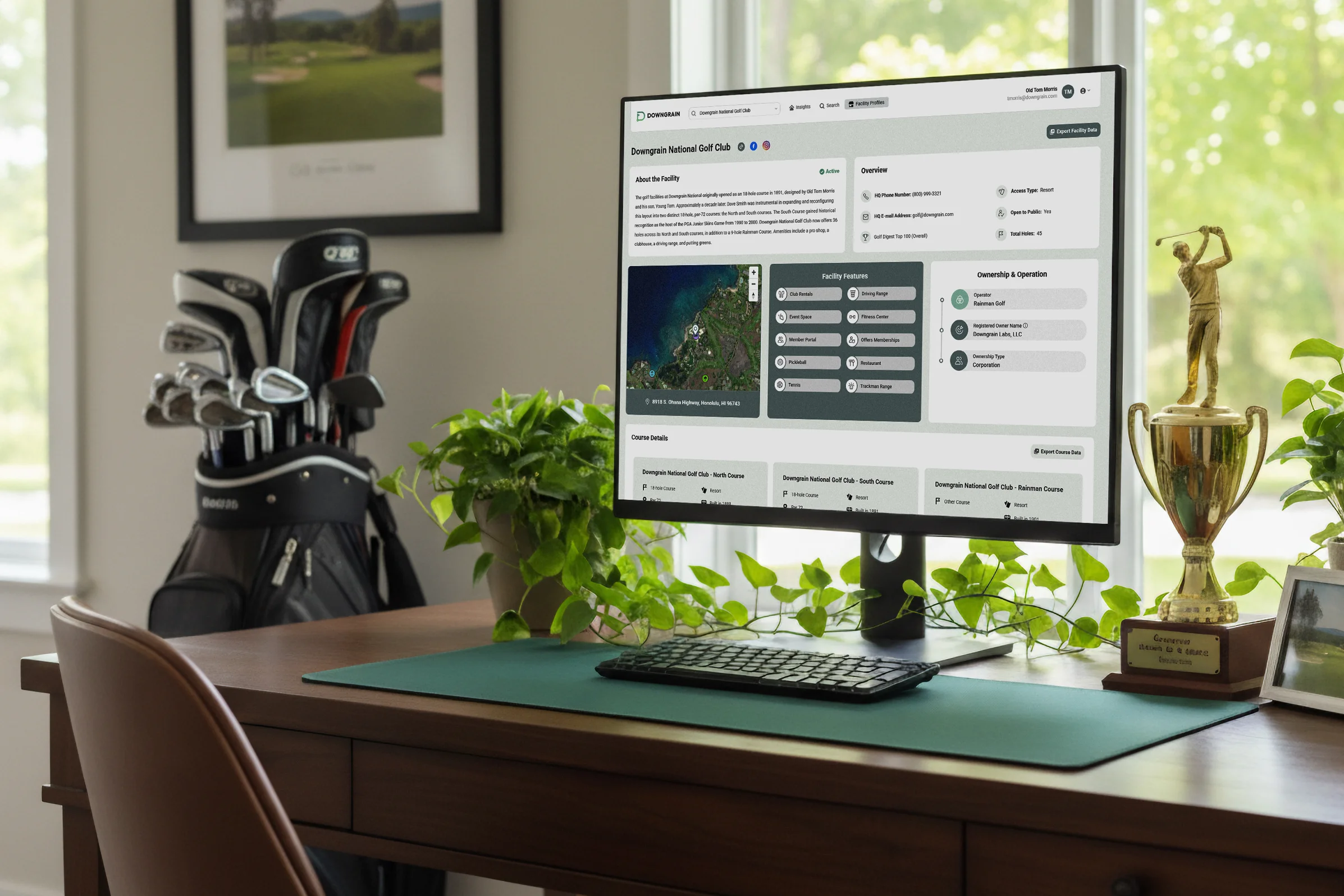

The world’s best B2B prospecting and intelligence platforms are incredible.
They just do not work for golf.
In January 2025, when I had just started collecting data for Downgrain, I walked the PGA Exhibitor showroom asking sellers about the data they use to go to market.
“Yeah, we looked at tools like ZoomInfo and Apollo, but they just didn’t really have the data we needed.”
That caught me off guard. I had spent over eight years building some of the most sophisticated processes and pipelines for curating B2B data at ZoomInfo. I knew our platform had the most accurate and complete data in the world.
So why were they failing for these golf brands?
I can now confidently answer that question after 18+ months of building a purpose-built golf intelligence platform. Throughout the creation of our platform, we tried to employ many of the standard B2B data techniques that drive operations behind leading intelligence platforms. Some would call these techniques best practices. Yet somehow, they fell short when it came to profiling golf facilities.
At first, I was dejected. Building a hyper-accurate directory of golf courses and the people who work there was not as easy as I thought it would be. But then I got excited. I realized that if we put in the time to do this right, it would be very hard for anyone to replicate. Those speed bumps forced us to learn how golf businesses go to market and, more importantly, why traditional sales intelligence platforms are unable to serve them.
Here’s a deeper look at where standard B2B prospecting and intelligence solutions struggle to capture the nuance of the golf industry:
LinkedIn Isn’t Very Helpful for Reaching Employees of Golf Courses
To the traditional B2B salesperson, LinkedIn is the de facto directory of companies and contacts. Most budget-friendly, lower-quality sales intelligence platforms operate almost entirely off scraped LinkedIn data.
Here’s the problem for golf businesses. That municipal golf course down the street does not have a company profile on LinkedIn. You are also unlikely to find their superintendent there.
Most golf professionals spend their days on the course, not on social media. Head pros are on the driving range. Superintendents are inspecting bunkers. They are not sharing motivational stories on LinkedIn.
What this means is that when you look inside traditional sales intelligence platforms for smaller golf courses or the people who work at them, you are left underwhelmed by the coverage.
The real data on who makes decisions at golf courses lives in industry-specific sources such as monthly club newsletters, PGA directories, and obscure corners of club websites. You have to dig for this data, and that is something platforms trying to cover millions of businesses cannot afford to do.
Courses and People in Golf Turn Over Much Faster Than Traditional Businesses
When golf courses get sold, the owner often changes the name. The location does not change. It is still the same land and the same address, but now it is called something else.
Complete rebrandings are rare in the corporate world, but they are commonplace in golf.
To catch ownership changes and rebrands in the golf space, you have to monitor a wide range of signals such as Facebook URLs changing, websites going offline, and local news coverage. We monitor all of these to track when golf clubs change identities.
But it is not just the courses themselves. Golf is a high-turnover industry.
The average GM of a private club stays in their role for two to three years. The average Director of Golf lasts around five years. This creates a revolving door of decision-makers.
That GM’s LinkedIn profile with three connections from 2007 is probably not going to be accurate.
That is why we have built data pipelines specifically designed to track additions and departures across these fragmented sources.
Who Makes the Decisions? It’s Complicated
Who decides what a golf course buys? It depends.
Sometimes it is the owner. Sometimes it is the GM. Sometimes it is a management company.
I will admit it. I did not know what a multi-course operator, or MCO, was when I started this company. But you cannot understand decision-making in golf without understanding MCOs.
For over 2,000 courses, spending decisions are primarily made by companies that specialize in operating golf courses. Owners delegate operations to these firms to maximize revenue.
Then there are member-owned clubs, which operate under boards of directors. Leadership changes frequently, and decisions are made collectively.
And what about municipally owned courses? The decision-maker might be the Director of Parks and Recreation, or it might be the Head Professional making a recommendation to the city.
On top of that, most municipal spending goes through a public RFP process. So even if you reach the right person, you still have to navigate a lengthy procurement cycle.
Now let’s talk about ownership.
How do you track owners in a sales intelligence platform centered around company websites and business emails?
Often, golf course owners are individuals, consumers who love golf. Other times, they are companies that own portfolios of courses.
Traditional B2B platforms do not track consumer data, and they certainly do not map which courses belong to operators like KemperSports.
Most platforms do not even understand what an MCO is. They do not know ownership type, let alone the actual owner.
We do.
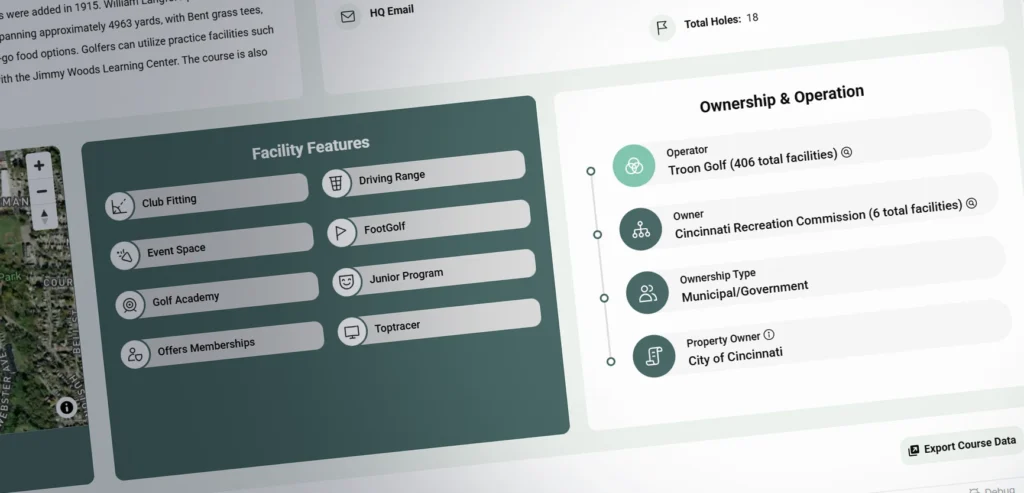
We crawl every MCO website. We monitor them for changes. We map golf course parcels to property owners and trace those entities back to the individuals behind them.
That is what separates us.
Golf Course Names Are a Nightmare for Matching
Most B2B platforms rely on domains to distinguish companies.
A typical company has a website and email addresses tied to its domain. No two companies share the same domain, which makes it a clean identifier.
That approach breaks down quickly in golf.
Municipal employees often share domains with their city or county, which leads to misclassification. That is how you end up with a “General Manager, Water and Wastewater” listed as the GM of a golf course.
Multi-course operators create another issue. Companies like Invited Clubs or Troon often assign corporate email domains to employees across all their properties. This leads to over-combination, where a single company profile ends up with dozens of unrelated GMs.
Then there is the naming problem.
There are 15 courses named “Whispering Winds.” There are 18 courses named “Rolling Hills.”
So what do traditional sales intelligence platforms do when they see a person record for a GM at Whispering Winds Golf Course? They choose which of their multiple company profiles is most likely to employ that individual. They are almost always wrong.
At Downgrain, we built a golf-specific matching algorithm. We analyze both course names and facility names. We have identified thousands of alternate names. We ignore common words like “golf” and “country club” to reduce noise and improve accuracy.
Digital Presence and Employment Details Are Different in Golf
Roughly 10 percent of green grass golf facilities do not have a website. Approximately 20 percent rely on Facebook or Instagram as their primary online presence.
If you want to find out what is happening at Atwood Country Club in Kansas, you will not find a website. Their Facebook page, however, is full of updates on tournaments, amenities, and membership meetings.
Then you have elite clubs like Cypress Point or Whisper Rock that do not have public-facing websites. They still have staff, amenities, and ownership structures, but you have to look elsewhere to understand what is happening at those clubs.
There is also a meaningful difference between titles in golf.
Director of Golf, Director of Golf Instruction, and Director of Golf Maintenance are distinct roles. Most traditional intelligence platforms do not differentiate between them. If you search for Director of Golf, you will often get all three.
At Downgrain, we have defined 10 separate job functions to help users identify the exact types of people they need to reach.
It’s Simple. Golf Is a Very Niche Industry
So I will come back to my original point. I am a strong believer in the power of B2B sales intelligence platforms, especially the best ones like ZoomInfo.
But many niche industries operate in nuanced ways. It is not that large platforms could not track this golf-specific data. If they wanted to, they could likely do it better than anyone.
The reality is that it is not worth it for them.
It is not worth parsing Facebook posts to identify golf tournaments. It is not worth monitoring whether a club just added Lightspeed as its tee time engine. It is not worth tracking ownership changes across fragmented local sources.
But it is worth it to us.
Because this is what we do. We obsess over what is happening in the golf industry. We collect as much data as we can and package it into a platform built for a very specific type of customer.
People who need accurate, actionable information on golf facilities.